

For as long as I can remember, I’ve enjoyed following train movements: working out where a service has come from, where it is going and how it is progressing across the network.
There are already some excellent railway websites, with RealTimeTrains being the one I probably use most often. However, I’ve always wanted something a little more visual as well, something that combines detailed railway information with a map, a bit like FlightRadar24 does for aircraft.
That idea eventually became MapRail, and the website is now live.
Starting with the map
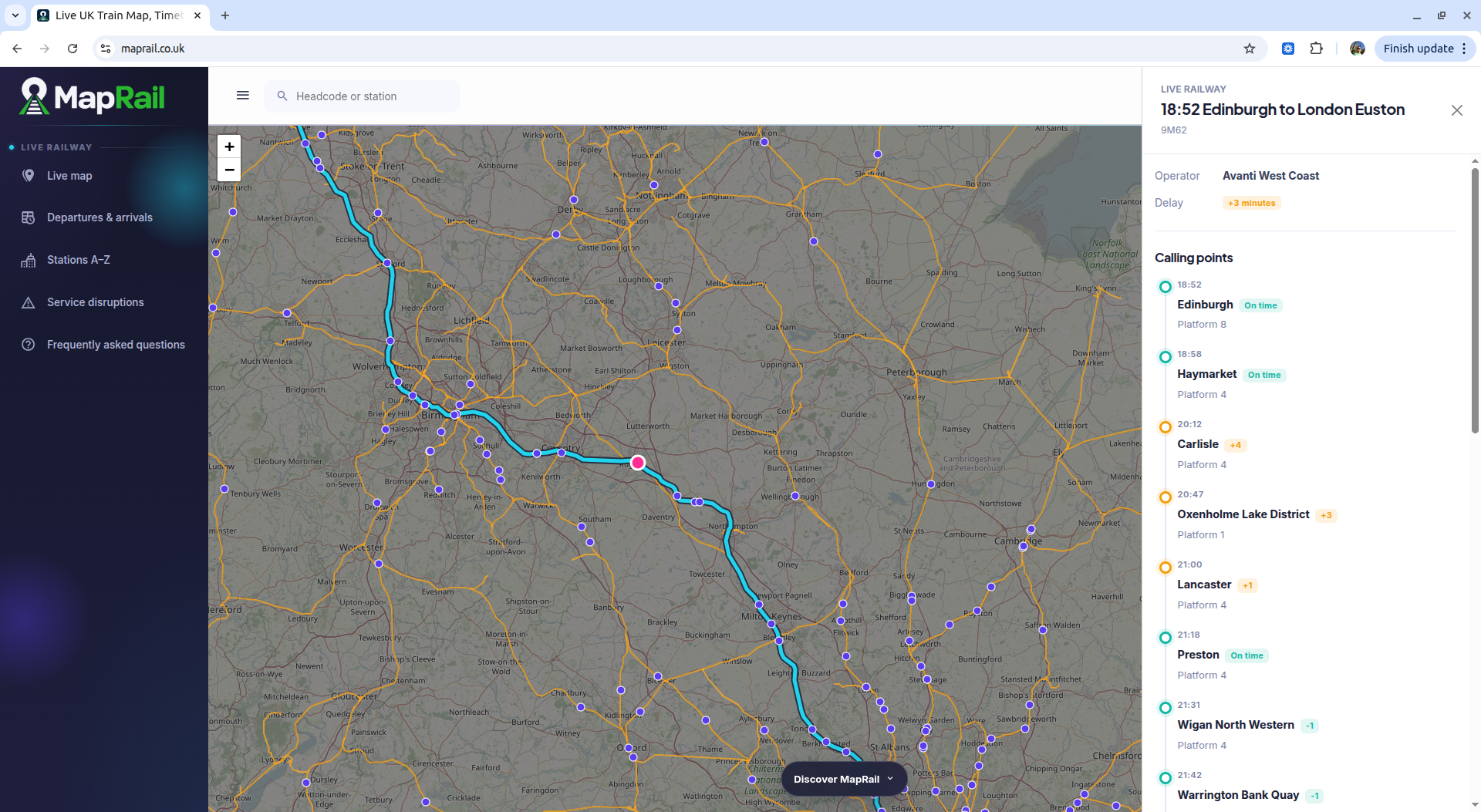
The main part of MapRail is an interactive map showing train movements across Great Britain.
You can zoom into a part of the network, see the trains being reported in that area and select one to find out more about it. Depending on the information available, this can include the train’s operator, route, calling points and current delay.
I find this especially useful when I notice a train passing somewhere and want to know what it is, or when I’m simply curious about what is running through a particular area.
Passenger and freight trains use different markers, which makes the map easier to read. Selecting a train highlights it so that it remains visible while moving around the map.
Looking beyond the marker
A moving marker is handy, but I think the timetable behind it tells the more interesting story.
Each service has its own timetable page, bringing together the planned schedule and any reported movements. Scheduled, confirmed and predicted times are shown separately, so it should be clear whether a train has actually reached a location or whether the displayed time is still an estimate.
There are two timetable views. The standard version concentrates on the places most people are likely to recognise, while the detailed version includes operational timing points such as junctions, loops, sidings and depots.
I’ve tried to expand railway abbreviations into readable location names wherever there is a reliable match. The operational detail is still there, but you do not necessarily need to know every railway code before you can make sense of a train’s route.
MapRail also keeps services linked to their operating date. This matters because headcodes are regularly reused, so the headcode alone is not always enough to identify one particular journey.
Passenger and freight movements
Including freight trains was important to me because they are such an interesting part of the railway, but they also present a few challenges.
Passenger trains can often be updated frequently enough to show fairly smooth movement between reporting points. Freight location information can be less frequent, so MapRail takes a more cautious approach. A freight marker moves when there is a confirmed report from a recognised signalling location rather than being animated along a route based on guesswork.
That means a freight train’s marker may sometimes remain in one place for a while before moving again. I would rather show its last confirmed location than make the map appear more precise than the available information really allows.
Other operational and special services may also appear when the timetable and signalling information make it possible to identify them.
Station pages and live boards
The site is not limited to following trains on the map. You can search for a station by its name or three-letter code and open a page showing its next arrivals and departures.
The boards can include scheduled, actual or predicted times, destinations and origins, platforms, operators, service identities and current delay information. Each train links back to its full timetable, so it is easy to move from a station board to the detail of an individual working.
There are also larger arrival and departure boards for looking further through the day. They are divided into manageable pages, which is particularly helpful at busy stations where displaying every service at once would quickly become unwieldy.
Where the information is available, station pages also contain details about facilities, accessibility and onward travel, together with any notices affecting the station.
Disruption information
MapRail has a separate disruptions section covering current incidents and planned engineering or service changes.
Disruption messages can also appear on the relevant station pages. I wanted this information to sit alongside the live boards and train movements, rather than requiring someone to visit several different parts of the site to understand what is happening.
That said, MapRail is an independent project rather than an official journey-planning service. Railway information can change quickly, so anything important should still be checked with the relevant train operator before travelling.
Searching and exploring
There are several ways to find something on MapRail.
You can explore the map, search for a station by name or code, look for a train using its headcode, browse the station directory, or search for arrivals and departures between two stations.
Sometimes I open the site looking for a particular service. At other times, I just browse the map, spot something interesting and follow it from there. That sort of unplanned exploring was one of the main reasons I wanted to build the site in the first place.
A personal railway project
MapRail started as a passion project built around the way I enjoy following the railway.
I wanted the visual appeal of a live map, but I did not want to lose the working timetable information and operational detail that make railway tracking interesting. Bringing those two sides together has involved plenty of experimenting with railway data, location reports, predictions and the different ways that passenger and freight trains are recorded.
There will inevitably be places where the available information is incomplete. My aim is to be open about those limitations and avoid presenting predictions or estimates as confirmed facts.
The site is now live, and most of its current information can be explored without an account. I’ll also be adding some member-only information shortly.
If you have an interest in railway operations, or just want to see what is running near you, I hope you enjoy having a look around MapRail.


